الأحد، 26 يوليو 2009

facts about Cancer


Cancer (medical term: malignant neoplasm) is a class of diseases in which a group of cells display uncontrolled growth (division beyond the normal limits), invasion (intrusion on and destruction of adjacent tissues), and sometimes metastasis (spread to other locations in the body via lymph or blood). These three malignant properties of cancers differentiate them from benign tumors, which are self-limited, and do not invade or metastasize. Most cancers form a tumor but some, like leukemia, do not. The branch of medicine concerned with the study, diagnosis, treatment, and prevention of cancer is oncology.

Cancer may affect people at all ages, even fetuses, but the risk for most varieties increases with age.[1] Cancer causes about 13% of all human deaths.[2] According to the American Cancer Society, 7.6 million people died from cancer in the world during 2007.[3] Cancers can affect all animals.

Nearly all cancers are caused by abnormalities in the genetic material of the transformed cells.[4] These abnormalities may be due to the effects of carcinogens, such as tobacco smoke, radiation, chemicals, or infectious agents. Other cancer-promoting genetic abnormalities may be randomly acquired through errors in DNA replication, or are inherited, and thus present in all cells from birth. The heritability of cancers are usually affected by complex interactions between carcinogens and the host's genome. New aspects of the genetics of cancer pathogenesis, such as DNA methylation, and microRNAs are increasingly recognized as important.

Genetic abnormalities found in cancer typically affect two general classes of genes. Cancer-promoting oncogenes are typically activated in cancer cells, giving those cells new properties, such as hyperactive growth and division, protection against programmed cell death, loss of respect for normal tissue boundaries, and the ability to become established in diverse tissue environments. Tumor suppressor genes are then inactivated in cancer cells, resulting in the loss of normal functions in those cells, such as accurate DNA replication, control over the cell cycle, orientation and adhesion within tissues, and interaction with protective cells of the immune system.

Diagnosis usually requires the histologic examination of a tissue biopsy specimen by a pathologist, although the initial indication of malignancy can be symptoms or radiographic imaging abnormalities. Most cancers can be treated and some cured, depending on the specific type, location, and stage. Once diagnosed, cancer is usually treated with a combination of surgery, chemotherapy and radiotherapy. As research develops, treatments are becoming more specific for different varieties of cancer. There has been significant progress in the development of targeted therapy drugs that act specifically on detectable molecular abnormalities in certain tumors, and which minimize damage to normal cells. The prognosis of cancer patients is most influenced by the type of cancer, as well as the stage, or extent of the disease. In addition, histologic grading and the presence of specific molecular markers can also be useful in establishing prognosis, as well as in determining individual treatments.

Mesothelioma - Wikipedia, the free encyclopedia

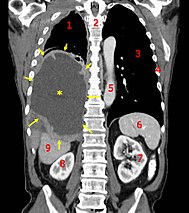
Mesothelioma - Wikipedia, the free encyclopedia: "Mesothelioma is a form of cancer that is almost always caused by exposure to asbestos. In this disease, malignant cells develop in the mesothelium, a protective lining that covers most of the body's internal organs. Its most common site is the pleura (outer lining of the lungs and internal chest wall), but it may also occur in the peritoneum (the lining of the abdominal cavity), the heart,[1] the pericardium (a sac that surrounds the heart) or tunica vaginalis.

Most people who develop mesothelioma have worked on jobs where they inhaled asbestos particles, or they have been exposed to asbestos dust and fiber in other ways. It has also been suggested that washing the clothes of a family member who worked with asbestos can put a person at risk for developing mesothelioma.[2] Unlike lung cancer, there is no association between mesothelioma and smoking, but smoking greatly increases risk of other asbestos-induced cancer.[3] Compensation via asbestos funds or lawsuits is an important issue in mesothelioma (see asbestos and the law).

The symptoms of mesothelioma include shortness of breath due to pleural effusion (fluid between the lung and the chest wall) or chest wall pain, and general symptoms such as weight loss. The diagnosis may be suspected with chest X-ray and CT scan, and is confirmed with a biopsy (tissue sample) and microscopic examination. A thoracoscopy (inserting a tube with a camera into the chest) can be used to take biopsies. It allows the introduction of substances such as talc to obliterate the pleural space (called pleurodesis), which prevents more fluid from accumulating and pressing on the lung. Despite treatment with chemotherapy, radiation therapy or sometimes surgery, the disease carries a poor prognosis. Research about screening tests for the early detection of mesothelioma is ongoing."

السبت، 25 يوليو 2009

Strange images of March 2009


صور منوعه


No Smokings plz


Forex Market | Forex Trading Tools | Foreign Currency Trading | Forex

Whether you need ideas for a new strategy, to brush up on platform tools, or just to learn our platform for the first time, we have the resources you need at FOREX.com. Open a free forex practice account to test your knowledge with no risk or obligation, attend a webinar, or check our schedule for a forex workshop in your area."

Learn How to Trade Forex like the pros!

Learn How to Trade Forex like the pros!: "Why should I learn Forex currency trading?

By reaching to our website, I think you are already aware that Forex trading is a good way to make money at home. More over, I bet you knew someone, or would have heard of someone, who's already making tons of good money in FX trading.

But what you wouldn't know is that 7 out of 10 traders keep losing money in Forex market! That's right, 70% of individual FX traders keep losing their hard-earned money in the market; while the rest of the 30% work freely at home and earn millions annually)

Wonder what differs between the losing 70% and the winning 30%?

Forex trading skills and the trading system! If you want to work less than 20 hours a day at home, if you want to make millions by trading freely at home, if you want to have financial freedom by trading Forex; you better LEARN Forex trading before you start trading Forex. Forex market is definitely not a game for newbie and you need to brush up your skills before getting your hands wet."